Erasmus Antiquariaat en Boekhandel, an organization with international clients,
is seeking a Pricing & Ordering Employee for 32 to 38 hours per week.
Erasmus Boekhandel supplies academic and art-related books to universities,
research institutes, and museums worldwide. The position begins on January
1, 2027 and offers the prospect of a permanent contract starting with a
fixed one-year term.
Organization Profile
Established in 1934, Erasmus Boekhandel has grown into a leading
international player in the academic bookselling sector. With offices in
Amsterdam and Paris, the company works daily to deliver knowledge and culture
to libraries and institutions across the globe. Approximately fifty employees
work at the Amsterdam office, distributed across various departments. The
atmosphere is personal and informal. You can find more information about us at www.erasmusbooks.nl.
Tasks and responsibilities:
Administrative processing of procurement within an automated system
Accurate
handling of incoming orders and claims
Keeping
relevant professional knowledge up to date
Maintaining
contact with international publishers
This is an independent role in which you provide support within a
customer-oriented organization.
Job Requirements
At least an
MBO (secondary vocational) level of education and professional ability
A minimum of
2–3 years of relevant work experience in an administrative role, preferably
within a bookstore or publishing house
A practical
mindset; you are accurate, customer-focused, and possess strong communication
skills
Proficiency
with CRM software and MS Office
Good command
of the Dutch and English languages, both spoken and written. Knowledge of
German/French or another language is a plus
An affinity
for books
We offer:
A gross
monthly salary between
A permanent
position, starting with a one-year contract
A 13th-month
payment
24 vacation
days plus additional time-off (ATV) hours for full-time employment
Please submit your application (cover letter and CV) by December 7, 2026
to: Charlynn van ‘t Riet, HR Manager, at
hr@erasmusbooks.nl.
Publications of uncertain relevance
Posted on
.
The publishing landscape is changing rapidly. AI-generated books,
self-published titles, and automated reprints of public-domain material are
increasingly appearing alongside traditionally published books.
Some of these are legitimate
publications, but many others are of poor or inconsistent quality. They may
have limited editorial oversight, unreliable metadata, poor formatting, or
production quality, or offer little added value compared with content already
freely available.
The growing number of such
publications can create significant challenges for title selection and
collection development, particularly when large quantities of titles enter the
market without the editorial and quality-control processes traditionally associated
with professional publishing.
To help our customers identify
these publications more easily, we have introduced an “Uncertain relevance
publisher” tag on our website. The tag identifies titles from publishers whose
output we believe warrants additional scrutiny when making selection decisions.
The tag is intended to support
informed selection rather than automatically exclude individual titles. We
continuously monitor developments in the publishing market and regularly review
and update the publishers covered by the tag.
Erasmus at LundOnline 2026
Posted on
.
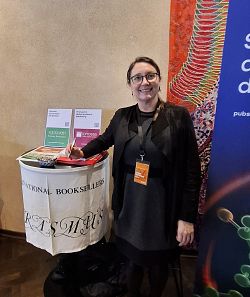
Last week, our sales manager Joleen attended LundOnline 2026 in Lund (14–16 October), representing Erasmus Boekhandel at one of the key forums for scholarly communication in the Nordic region.
LundOnline is a biennial conference organised by the Department of Scholarly Communication at Lund University Library, bringing together academic librarians, publishers and other stakeholders to discuss developments and challenges in academic publishing. This year’s programme covered open access and sustainability, national consortium strategies, AI in scholarly publishing, and the implications of CoARA for research evaluation. These are all topics that sit at the heart of how academic libraries are evolving as collections and procurement change.
It was a valuable few days of conversations with librarians from across the Nordic region. If you’d like to continue the conversation, don’t hesitate to get in touch.
Torrossa Digital Library surpasses 750 publishers
Posted on
.
Erasmus Boekhandel, in partnership with Casalini Libri, announces that
the Torrossa Digital Library now includes ebooks and ejournals from more than
750 publishers across Europe and beyond.
The publisher list reads like a map of scholarly publishing itself:
long-established university presses such as Oxford University Press, Princeton
University Press and Il Mulino sit alongside major international houses like De
Gruyter, Bloomsbury, Wiley, and Brepols, and specialist imprints covering
everything from classical archaeology to contemporary art history. French,
Spanish, German, Italian and Dutch publishers all have a strong presence,
including L'Harmattan, Franco Angeli and Duncker & Humblot to name a few.
The
750-publisher mark reflects sustained growth for the platform, with new
publishers added on an ongoing basis across the humanities, law, social
sciences and the arts. For research libraries and institutions building or
expanding collections, it marks Torrossa's continued emergence as a significant
resource for academic publishing.
Erasmus recognized for its role in joint efforts to exclude books from the EUDR
Posted on
.
Erasmus
Boekhandel has been recognized by the Koninklijke Boekverkopersbond
(KBb) for its significant collaborative role, alongside KBb, the
European and International Booksellers Federation (EIBF), LIBER, and
other organizations, in successfully ensuring that books were exempted
from the EU Deforestation Regulation (EUDR). https://www.boekbond.nl/goed-nieuws-boeken-uitgesloten-van-de-eudr-ontbossingswet/
Through
coordinated national and European advocacy, we highlighted that books
and other printed materials pose no deforestation risk due to their
reliance on certified, recycled or sustainably sourced paper. Our joint
lobbying helped convince the European Parliament, the European
Commission and the Council that including finished printed products in
the EUDR would disproportionately burden the book sector, threaten
supply chains, and limit citizens’ access to knowledge and culture.
The
collective efforts contributed to the EU’s decision in December 2025 to
formally exclude books and other printed materials from the scope of
the regulation. This outcome safeguards cultural diversity, academic
access and the free circulation of books across Europe.